Wednesday, May 9, 2012

Picturing Humanity - Lee Sang-il’s VILLAIN is a new kind of Noir.


Sang-il Lee’s film Villain (2010) One of the benchmark selections of the Japan Society of NY’s Korean/Japanese crossover film series Love Will Tear Us Apart. Villain is an elegant and unsettling exercise in the eroticism of loneliness, centered on the murder of a young woman and the small constellation of people drawn into the turmoil. Director Sang-il Lee’s award winning adaptation of Yoshida Shuichi’s likewise celebrated novel (of the same name) is most alluring for its urgent score and clean visual aesthetic, which transposes a contemporary horror-genre aesthetic to an emotive human drama. Villain traces its mood and its sense of melodrama back to the days of American Film Noir, a genre of the 40’s and 50’s dedicated to common people caught in exceptional orbits of loneliness, violence, and desperation, driven to their worst. These associations aside, Lee’s film, both classic and contemporary, is most affecting because of the palpably broken hearts put forward by its cast, which Lee’s sense of framing and editing ardently emphasizes. 

Though the subject of director Lee’s Zainichi (Japanese-born Korean) ethnicity isn’t necessary to understand or even appreciate this film, it seems hard to imagine that it did not inform his depiction of protagonist Yuichi, at odds with the normal stream of society, who hates with the passion with which he loves.

Yuichi (Satoshi Tsumabuki) lives in a dreary Nagasaki fishing village, daunted by the visage of a wide ocean. “If you face the sea everyday, you feel like you've reached a dead-end.” He has no friends, and no lover. He works construction jobs and looks after his aging grandparents. Short on words and yet driven by fierce desire, Yuichi could nearly have stepped out from a Ki-duk Kim film. The only thing Yuichi is beholden to his extravagant car, which he uses to escape the imprisonment of an otherwise stagnant existence. Mitsuyo (Eri Fukatsu) lives in an equivalent monotony in Saga, working at a men’s clothing store along the same street that she was born and raised. She shares an apartment with her sister, whose boyfriend is a reminder of Mitsuyo’s single-ness. Yuichi and Mitsuyo discover each other on an online dating site, and when they meet in person, they fall into an obscure and clumsy love. Around this time, a woman’s body is found at Mitsue Pass, and Yuichi is implicated as a murder suspect.
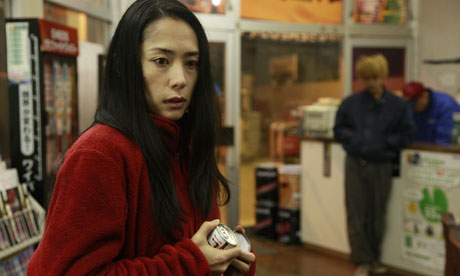
Yuichi and Mitsuyo try to evade the police, as the murder, its participants, and its aftermath are gradually revealed in the present and flashback. Through the victims, the murderer, and the families that lie in the fallout of this tragedy, Villain makes one wonder; should someone be judged upon their worst or best moments - their most wholesome or most selfish impulse?

One could easily imagine Villain translated to the 40’s, or any other decade of the 20th century for that matter. What holds Villain to the present is primarily its objective time markers; phones, email, online-dating. The existential urgency that encircles these embedded elements, and the false autonomy that new technological forms have always engendered, isn’t a new phenomenon. Yuichi follows the age-old paradigm of getting a car to feel “adult” and “free.” Lee’s soft inclusion of these components – another similarity between he and Ki-duk Kim - is a compliment to the story’s human focus and is the crux of its timelessness. All things being equal, the desolation of Yuichi’s traditional hometown is the desolation of Mitsuyo’s modern hometown, is the desolation of empty nighttime roads, is the desolation of a lighthouse, is the desolation of hearts so eager to be touched and accepted, is the desolation of love diffused across emails and text messages, is the desolation of secrets.

Director Sang-il Lee’s chose Yoshida Shuichi, author of the original source novel, to co-write the script. This is often (but not always) a boon to the resulting film, not just as a matter of credibility, but because a formative collaboration occurs between two very different modes of storytelling that expand and contract a story when they come into contact. In the realm of the written word, a reader’s imagination is the camera. The reader births imagery from within, and makes the experience of an author’s specific words entirely idiosyncratic to their mind’s eye. However, with cinema the architecture of another world is imagined for the viewer. Therefore the abstraction of interpreting written words, which is the thrilling basis of reading, can be found cinematically in a filmmaker’s ability to create spaces of ambiguity, subtlety, and silence. Inside these spaces, a viewer asks questions, injects their imagination, and makes connections.

Director Lee and author Yoshida balance the brooding weight of what is shown in Villain with what isn’t shown. As actress Eri Fukatsu speaks of Mitsuyo, “She isn’t a character that can be understood in the mind. She is moved by a force rather than a rational thought.” After connecting emotionally to the film, this systemic and enigmatic “force,” is the space and silence that the viewer is charged to interpret. Villain’s final frames create an expanse all their own.


Wednesday, February 15, 2012

WITHOUT A SCREEN - Proof By Contradiction


In response to the On-Demand release of David Mackenzie’s Perfect Sense, which enjoyed screenings at the 2011 Philadelphia Film Festival, Without A Screen curates a hypothetical series of sense-related cinema. Films of the Proof By Contradiction subset explore humanity through its negation, where various human biological functions are crippled to produce platforms of existential inquiry. In the case of Perfect Sense it is the senses themselves slain by a mysterious and indiscriminant epidemic, which sweeps the globe in stages. The consequences and adaptations, which stem from that loss, are expressed in intimate scale between a Chef named Michael (Ewan McGregor) and a scientist named Susan (Eva Green). Their lives, together and apart, are macrocosmic prisms for a global event. Our physical capacities (senses) are inextricably entwined with our cognitive and emotional being (identity). Proof By Contradiction films posit this mind-body contiguity by displacing it. 

The films selected for Proof By Contradiction affect as deeply and memorably as they do because they are, point of fact, human, universal. They appeal to our most corporeal and emotional selves, while challenging expectations and perceptions of the body and of personhood. The things at stake in such narratives are those most basic modes of our experience (the functions of the human body), and that which we accrue through experience and reform into identity. Incidentally, these functions (sensory perception, biological functions) are the things taken most for granted because they are as buried in the programming as instinct. Oppositely, society venerates those who gain mastery of the senses, and derides any compromise of those faculties. The most telling truths however reside in the revolutionary event of adaptation, wherein lies the proof of humanity. Proof By Contradiction collects films that document this event, in response to revocation, or to the introduction of new social paradigms concerning “the body.”

Dancer In The Dark (2000) – Selma (Bjork) works herself to the bone, saving money to pay for her son Gene’s eye operation. She keeps this fact secret from Gene, for fear of escalating his condition through worry. In the doldrums of work and a marginal existence, her imagination sets fly into elaborate musical numbers that incorporate the elements and sounds of her environment; ie the industrial machines at the plant, the nearby trains. Selma too is going blind, and is nearly so. Her ability to work, the joy she derives from seeing the world, and her elation about participating in a local musical production constantly decline. A tragic line of causality leads her into the direst circumstances, where her hard-earned money and therefore her son’s operation are in jeopardy. Lars Von Trier’s film is brilliantly manipulative on an emotional front, yet its unvarnished expression and life-imbued performances render Dancer In The Dark earnest and authentic. The dramatic use of the “musical film” form is all the more rending because of these qualities as well.

Children of Men (2006) - Women have stopped conceiving. A child hasn’t been born in almost 20 years, without any explanation. Societies and values crumble in reaction to the seeming inevitability of human extinction, raging against their powerlessness to stop it. A band of rebels aim to get a woman of unique importance to the coast as they encounter conditions reminiscent of the holocaust. Direcor Alfonso Cuaron creates a desperate world of remarkable tactility, wherein the tactility is its greatest sensationalism. Cuaron’s spectacle has gravity and he explores the experience of a world rendered infertile on the scale of individuals.

Love and Honor (Bushi no Ichibun, 2006) – Shinnojo is a young samurai with dreams of opening a kendo school for young boys. He lives peacefully with his wife in a modest but beautiful home. To his disappointment he is assigned as a food taster for his feudal lord. During a routine tasting, he is struck with fever and goes blind. Investigations reveal that an out of season shell-fish was the cause. Relegated to his home, Shinnojo undergoes an existential crisis, where his capacities as a samurai and a caretaker are challenged. He rises to the occasion however, when his wife is marred by a high-ranking samurai’s amorality. Yamada explores the drama as a subject and blindness as an object. Within a society of such fastidiousness, ritual, and formal precision, it is all the more compelling to observe someone navigate an incapacity to participate in that behavior. His film has a small scale, and is all the better for its lack of irony. With Love And Honor as example, Yamada is a master of negotiating the line between sensitivity and sentimentality.

The Fly (1986) - A reclusive scientific genius named Seth Brundle (Jeff Golblum at his absolute best) is troubleshooting a short-range teleportation device. When a fly is trapped in the machine during a test, the machine combines its DNA with Brundle’s, and he finds himself slowly mutating into a human-fly hybrid. Verinica Quaife, the journalist documenting Brundle’s experiments and falling in love in the process, is  powerless to stop the degradation. Cronenberg’s visionary work devastates as it dissolves a man’s humanity piece by piece, and yet invigorates the human spirit as Brundle feverishly works to undo the mistake and teach his machine the distinctness of forms.

28 Days Later (2003) – The Rage Virus, an infection of the blood which limits the human emotional spectrum to unadulterated anger, spreads across England and presumably the world. Danny Boyle drops us into the middle of the melee, as confused and fearful as Jim (Cillian Murphy), who wakes from a coma to a desolate and littered London. He joins a small band of survivors that do whatever they can to stay alive. Along the way, Boyle expresses many attitudes towards this new paradigm of living, and the seemingly hopeless prospects for a future. The removal of emotions renders humans into a loosed rabid animal, and 28 Days Later wonders to what degree our emotional agency determines our personhood. Boyle shows rather than tells, with unrefined grit.

Womb (2010) – Rebecca (Eva Green) and Thomas (Matt Smith) are childhood best friends, and also each other’s first love. They are separated when she is relocated to Japan, but returns to the seaside town of their youthful days after college. Thomas still lives there, and they begin to reconnect, remembering the bond of their childhood. Tragedy separates them once more, but they are “reunited” when Rebecca makes a controversial decision to give Thomas a second chance at life. Womb is achingly beautiful, and cool to the touch. Its mood is rarefied, and its time is unfixable.

Never Let Me Go (2010) - As children, Ruth, Kathy and Tommy, attend an English boarding school, and director Mark Romanek entreats us to the devastating social and emotional turmoil inherent in such an environment. Now come of age, and placed in halfway houses associated to the school, the trio find themselves coming to terms with complexities of their reality and their shared histories. With time advancing on the guarded purposes of their existence, they prepare themselves for a haunting prospect. Like Womb, the future feels distinctly like the present (if not timeless), which makes Never Let Me Go all the more effective on an emotional appeal.


Without A Screen : Zaha Hadid’s Cinema of Form


Through March 25th the Philadelphia Museum of Art’s Perlman Building hosts Form in Motion; a groundbreaking exhibition of Iraqi-born British architect Zaha Hadid’s sculptural design. Winner of numerous awards for her daring and originality, Hadid is under commission for the 2012 London Olympics. In fact, her creations are currently being built in 40 different countries. Her combination of protrusive organic formations, linear embellishments, futuristic sensibilities, and grand scale might well make her worlds first Naturo-Brutalist for all her forceful presence. For this unique site-specific exhibition – the first solo exhibition of her product designs in the US – Hadid orchestrates a “carefully controlled movement through space,” which suggests to the author, an analogy to the action of filmmaking, and to the experience of cinema. (Hiesinge) Where cinema creates form from movement, Hadid creates movement from form. Her objects and her environment are sinuous and continuous.

Without A Screen responds to the experiential exhibition and Hadid’s distinctly sensuous voice with a hypothetical film curatorial. These interpretive associations between Form In Motion and particular films are fluid and subjective, and not meant to insinuate deliberate references on the part of the artist. Some connections are obvious and material, others are abstract and stream of consciousness, but all are intuitive.  

More than a mere selection of Hadid’s sculptural objects – not all of which will be discussed - the gallery at the Perlman is rendered into an “interior landscape,” where structure, terrain, space and light are augmented to fuse a sense of inside and outside, design and nature. Though Form in Motion imparts an overall sense of sterility - due to its limited palate (black, white, grey/silver) and the laser precision of its surfaces - Hadid elicits entropy and erosion in her references. Whether remarking on her sofas, tables, “lounge” chairs, shoes, twisting neon chandeliers, or waveform architectural walls, Hadid’s formations are akin to those arrived at in nature by geologic processes like erosion. Hadid distills and refines her futuristic forms through the most advanced materials and fabrication techniques; a juxtaposition of organic resemblances and industrial processes.


One’s first encounter in Form in Motion is an open circular antechamber, the ceiling of which is partially domed. For individuals beneath the circumference of the dome, sounds made within that same space (ones own voice, footsteps, shuffling, breathing) amplify and reverberate. Hadid’s dome creates a privatized sensory event that envelopes the experiencer(s) with its cinematic fullness, as well as its finitude. In effect, she washes away the recent history of each viewer, prepares them for the exaggerated quality of her forms, and reminds the viewer of their integral part in the equation of art. The white floor is marked here with broad curling strokes of black, evocative of waves or even tribal iconography. The marks, flowing from inside the gallery proper, have both a coaxing undercurrent and an expulsive push. As if wading upstream in the ripples, one enters into Form in Motion where the artist presents a visual timeframe that is both primordial and ultramodern, wherein the individual provides the “present.”
Astride the futuristically chic Zephyr sofa at the fore of the main gallery, are two curving neon Vortexx Chandeliers that funnel down from the ceiling and bask a white stage in shifting colored light. They strongly evoke the neon-embellished industrial designs of Tron Legacy (2011) as much as they do the warped architectural forms of Catalan architect Antonio Gaudi (1852-1926). Hadid’s association to Gaudi, appropriate to much of her work, can be fully appreciated in the visual documentary Antonio Gaudi (1972); director Hiroshi Teshigahara’s own poetic “carefully controlled movement” through beguiling manipulations of space and form. The Vortexx Chandeliers appear to be simple free-form spirals, but closer inspection reveals the elegance of Hadid’s tangles. Each Chandelier, varied on the same warped spiral movement, eventually twists up through its own center and back onto itself. The effect is Mobius-like. Filmmaker David Lynch comes to mind, having performed a similar act of inversion, in narrative terms, with the structure of Lost Highway (1997). While in prison for a terrible crime, a disturbed musician named Fred Madison (Bill Pullman) undergoes an identity-fugue. By becoming a much younger man named Pete Dayton (Balthazar Getty), he finds himself living a new almost diametric life. Lynch convolutedly and terrifyingly leads Pete back around to his former identity, not unlike what Hadid does with her Chandeliers, and also with the gallery; returning the viewer to an experience of themself in the antechamber as they exit.

Turning one’s attention from the Vortexx Chandeliers, Hadid’s creative inclusion of the floor becomes evident. The black graphic striations, continued from the antechamber, read like rippled reflections of the undulating wall structure that runs along the entire left side of the gallery. Her graphic references are to the ebb and flow of the nearby Schuylkill River, and its understated significance to the formation of the area. The opening shots of Rian Johnson’s High School set neo-noir Brick (2005) surface in thought. Indelibly imprinted with their bluish tint and tinkering incidental music, Johnson reveals a dead girl’s braceletted hand lapped by the soft ripples of a creek. This image sets the dramatic entropy of the film motion. South Korean filmmaker Chang-dong Lee’s film Poetry (2010) also begins and ends with the ebb and flow of a river that buoys yet another dead girl’s body. The girl’s cause of death bears great consequence for Mija (Jeong-hie Yun), an old optimistic woman raising her snide grandson, consumed by a late-life interest in writing poetry. Like Form in Motion, Poetry contains a liquid constancy throughout its deliberate anticlimaxes. Ruminations on Brick and Poetry infuse Hadid’s “river” with an unintentionally somber essence.

The river, and the aforementioned “waveform wall structure,” have a distinct relationship to one another. Built into the gallery itself, the wall functions as an object, a stage for other objects, and barrier to create a space-within-a-space; a concealed video lounge featuring computer generated models of Hadid’s architectural projects. The wall’s stacked topographical construction recalls sedimentary formations and the rivulets of dessert sands. No film has ever extracted greater poetry out of sand than Hiroshi Teshigahara’s Woman in the Dunes (1964), about a nameless man on a quest to discover a new species of beetle in the dessert. He finds himself forcibly sharing a house with a woman at the bottom of a giant sand pit, and the film depicts his feverish stages of reaction to this situation. Looking up at the wall, one feels as the film’s nameless protagonist might; daunted by the imposing enormity. Teshigahara’s adaptation of author Kobo Abe’s existential masterwork is a visually textural experience (sand, flesh, water, sweat, wood), and for that fact, the smoothness and starkness of Hadid’s wall feels all-the-more like a polished abstraction of natural formations.  The river flows round the wall, responding to it and shaping it. All the objects placed on the floor space are also shaped roundly by the erosive flow of “water.”

Elongated barnacle-like growths emerge from the wall, around the far bend. Their pearlescent-grey scooped-out contours could almost cradle a human body, and inspire a vague recollection of Japan’s infamous capsule hotels. A much more subjective association to Hadid’s capsule forms is yet again from Woman in the Dunes. The nameless man sits inside a small abandoned skiff, slowly being consumed by desert sands. This existentially ripe image of a landlocked seacraft has appeared in numerous films - Never Let Me Go (2011), and Ki-duk Kim’s Samaritan Girl (2004) to name a few. The boat’s form, and therefore its emptiness are asserted by its unconventional locale, just as Hadid’s capsules raise curiosities about their proportional relationship to the human body vs. their vertical arrangement.

The movement of the exhibition – the overriding directionality of the wall / floor-piece, and the smooth curvature of all Hadid’s sculptural forms - has a kinship to the elliptical cinematography of Taiwanese filmmaker Hou Hsiao-hsien. In particular, Form In Motion recalls Café Lumiere, Hou’s homage to Yasujro Ozu. The film patiently revolves around Yoko, a young and suddenly pregnant Japanese woman researching a Taiwanese composer. The film is airy and crisp in its simplicity as Hou negotiates Yoko’s relationship with her parents, her quietly budding friendship to a bookstore clerk, and to the city itself. As always, Hou’s camera follows the movement of individuals in spaces from relatively fixed perspectives, without breaking continuity. The unblinking lens allows the viewer to enter fully into Café Lumiere’s environs, and to bask in the days’ softly diffused light. Café Lumiere draws parallels between the chaotic-yet-regulated beauty of Tokyo’s rail systems, and the chaotic-yet-regulated courses of individuals. It isn’t difficult to extract Hadid’s river from Hou’s rails.


Wednesday, December 28, 2011

OCCUPY NOWHERE FINALE: United Red Army (2007)


As films were mined each week for Occupy Nowhere, two camps emerged from within the loose genre framework that the column intended to elucidate. It became relatively consistent that for characters that deliberately and knowingly occupied a particular nowhere, the act was one of diversion and avoidance (The Woman With Red Hair) of the greater tides of change. These tales tend toward incongruities of personal growth (Young Adam) and err on the side of defeatism. However, for films in which exile is forced (The Skin I Live In, Woman in the Dunes, Pleasantville), a more substantive course is undertaken. Individuals in the latter camp prove themselves industrious, inventive, and introspective. Certainly, this genre split is imperfect, with the example of Matthew of The Dreamers who is invited into exile and evolves within that shared seclusion where his counterparts Theo and Isa do not. What the draw suggests is that imprisonment foments reactivity and adaptation. Survival instincts streamline human ingenuity, ferocity, and also patience, therefore the more engaged exile is the one who finds themself occupying nowhere (World On A Wire), not the one who decides to.

Though both camps of films are uniquely existential, the result of diversion tends to somatic or bodily (The Dreamers, Young Adam), and where imprisonment is the mandate, the result is something more cerebral. Like The Skin I Live In, which uses sexual reassignment as the material for one man’s undoing and another’s existential evolution, Director/Writer Koji Wakamatsu’s incendiary sociopolitical drama United Red Army inhabits a middle-ground (a nowhere even within the Occupy Nowhere dichotomy) where its matters of deliberate seclusion by radical communist youth in “military camps” yields both an intensely cerebral and deeply somatic product, fusing the connection between physicality and the phenomenon of ideology. URA creates a new paradigm of nowhere, in which nowhere is occupied deliberately, not as a diversion from the tides of change, rather a preparation for them.

United Red Army (URA) is a film I never thought I’d see twice, much less theatrically, but this is exactly what has happened. URA screened at the NY Japan Society in 2008 and quite recently in Washington DC’s Freer Gallery (which boasts excellent free film screenings). Much to this reviewer’s surprise, URA is even receiving a US DVD edition on January 17th from Kino/Lorber. Wakamatsu, who has been making films since the events of URA took place, is no stranger to the unsavory dimensions of the human psyche or to the left-wing political wildfire that lapped Japan’s mid century. He is remarkably unflinching and unsparing in his vision, so much so that in the two years that lapsed between viewings, precious little detail had been swiped from memory, and all the stains of its rigor were in tact.

A perfect candidate for Occupy Nowhere, this three-hour three-act epic is an expository docu-drama about the uniquely radical politics of protest in 1960’s-70’s Japan. Analogous to numerous student uprisings the world over – which the film draws its own connections to - Japan too was creaking and moaning as it grappled with post war reshaping, but these growing pains escalated to a violence unseen anywhere else.

Wakamatsu takes on a reductive strategy with URA. Act one is a quickstep expositional history lesson aided by narration and archival material spliced with dramatization. It sweeps through the constellation of names entwined in the complicated causality that birthed with the National Student League in the mid 60’s, through the formation of the Red Army Faction from several radical sub-groups, and ends with the violent implosion of the United Red Army altogether in the early 70’s. Emerging from the tangled timeline, act two plunges into the radicalization, politicization and militarization of leftist student groups and their consolidation into the United Red Army’s now infamous training camps, with a turn towards visceral dramatization. Act three quarantines the characters and audience even further as it hurtles towards an action-thriller climax with URA members on the run from the police.

As per the second act, in an effort to ready themselves for the inevitable “all out war” that would decide the socio-political fate of Japan and the world, the United Red Army assembles in two isolated woodland camps to commence self-directed military training after unifying under the URA banner. The intent of occupying this nowhere is to sew bonds of friendship, instill the warrior instinct, and clarify the language of their political ideology. In camp is where the ultimately dismantling practice of self-critique, in which individuals are obliged to appraise and dissect their own “ability to be a communist,” takes its grip. In some form, self-critique could have been a helpful ritual of assessing ones actions and their impact on the cohesion and success of the URA’s movement, instead it becomes a stage to “thin the herd” of the weak hearted. The megalomaniacal leaders of these camps drive what becomes a cyclical degradation of purpose and functionality through the redundant practice of self-critique. The impending “all out war” that is the ultimate intent seems impossibly distant, and the camps turn on their own proponents.

Act two of URA bears all the fundamentalist finger-pointing shades of Arthur Miller’s The Crucible, in which any infraction, misstep, or objection is put under the microscope of a scrutiny that can never satisfied to the contrary, where the worst is drawn out of people and a grand potential for broadly scaled change is squandered. Petty motivations lead to victimization, and the demand for self-critique becomes a weapon. The critical point of abstraction occurs when self-critique exteriorizes to include the other members of the camp; meaning that, in the communist spirit of universality, the group becomes an extension of the individual, and is expected to critique with their fists. In that sense, all critique is self-critique, no matter where directed. This trend, which in a sense absolves anyone’s culpability through metaphor, escalates to the degree of “death sentences,” handed out by the titular leader. The intensely physical and psychological act-two stretches itself well past the point of the audience “getting it,” and rightly so. The confounding, enraging, and seemingly fruitless practice of self-critique is made as grueling and seemingly endless as possible to simulate the inescapable horror that it was for those encamped. Thankfully it breaks.

Act three is an even further distillation of filmmaking, and takes place as the remaining URA members of the training sessions are chased down by the police to the Asama Mountain Lodge (the director’s own lodge is used and destroyed in the film), knee deep in snow, forced to occupy yet another nowhere. However, this nowhere, like the Occupations on City Hall and Wall Street, is in plain sight, televised across Japan. These final members take the lodgekeeper hostage for 10 days as they are pushed to the brink of their own ideology, to the basest most modes of survival, and confront their ultimate failures as activists and as human beings. This final primal stretch of URA - a futile struggle helmed by cornered wolves raging against the dissolution of their newly consolidated form before any real war could be waged, before any change could be affected through direct action - is a confused barrage of attacks and counter attacks, told entirely from the frenetic perspective of the entrenched URA members. Wakamatsu, in the reductive end to his earnest, even, and ever-refining film keeps the audience cloistered in the lodge, as confused and confined as the trapped URA men, left to grapple with defeat and guilt in nowhere.


Friday, December 16, 2011

OCCUPY NOWHERE: WORLD ON A WIRE (Part II) (**spoilers**)


“The materialists say that ‘Thought is conditioned by Being,’ and not ‘Being is conditioned by Thought,’ and that Being - with its basis in itself – is conditioned by itself. …But it forgets that without thought, Being is No-Being. Being comes into Being only when it becomes conscious of itself. As long as God is content with himself, he is non-existent. He must be awakened to something that is not himself when he is God. God is God when God is not God, yet what is not God must be in himself too. And this – what is not himself – is his own thought or consciousness. With this consciousness he departs from himself and at the same time returns to himself. You cannot say that thought is conditioned by being, and that Being has its basis in itself. You must say that Being is Being because of Thought, which is to say, that Being is Being because Being is not Being.” 

"The world starts only when there is a mind that appreciates, a mind critically aware of itself." -Daistez T. Suzuki

At the end of part one (literally the last seconds), Fred Stiller is made privy to what a modern audience has likely suspected since Günther Lause’s split-second disappearance and certainly since Stiller’s drive to where “the road wasn't finished”; that Stiller’s world is a simulation. This means that Simulacron-3 is actually a sub-basement of reality, and furthermore that a dimension exists above Stiller’s world. What isn’t clear is precisely how many worlds are wrapped around one another (at the least, three), who is “real” and who is not (who is a Contact and who is merely an identity unit), and whether there is a way to escape the nowhere Stiller finds himself occupying; a nowhere more literally no-where than any other film in the Occupy catalogue for its “existing” in the digital abstract. Ironically though, Michael Ballhaus’ (The Departed, Quiz Show) cinematography has been asserting the notion of space, surface, dimension, and geometry with every sleek, gliding shot the whole film long.

Stiller’s persistent investigation along the hypothesis of corporate conspiracy, which stems from Vollmer’s death and Lause’s disappearance, takes on the concern of his world’s falsehood in Part Two. Stiller goes through a full course of emotional states, much like a grieving process as he negotiates a changing perception of reality, addled by a reality that keeps rearranging itself, and shaken by the question of personhood as he may in fact be just an identity unit. Is this not the same dismay or deflation one might feel about the notion of intelligent design, perceived as an existential challenge against ones own autonomy and agency rather than an infusion of purpose? Stiller’s ultimate insistence of his corporeality and intentionality splinters the preconception that personhood is an exclusively biological event.

World on a Wire questions where imitation ends and authenticity begins and posits a common science fiction bent that “something like human consciousness” could aspire to “become consciousness.”  Thus, as Buddhist scholar Daisetz Suzuki discusses in the opening quotation, Consciousness and Being qualify one another. Suzuki proposes that only through Thought – what he considers necessarily external to the individual’s autopilot existence - does Being quantify into Being (in the full sense of someone able to contemplate their own existence). Stiller rises from like-consciousness (or rather the no-consciousness of complacency) to consciousness by negation. He ideologically negates his inclusion in a reality determined to be a simulation. Thus he is able to differentiate his intent (conscious decision and opinion) from his action (his basic functions as an identity unit). Though yet to be proved as more than a computer program, Stiller is able to actualize and appraise his own Being-ness by verging against the medium in which he floats. In the language of Suzuki, Stiller is Stiller because Stiller is not Stiller, meaning that he comes into Being not when he is passively told he is no-being (an identity unit) by his mind-hacked coworker, but when he has proved it actively by unraveling the perceptual veil which aims to perplex him into subjugation.

Suzuki remarks of Zen that, “When we say that we live by Zen” …rather than simply living zen, which all life supposedly does passively…“this means that we become conscious of the fact,” and therefore active. Relational to Wire, it is Stiller’s achievement of “thought,” that brings him to a critically self-aware state, able to assess, dissect, and contradict Simulacron by degrees. Even though he verges against the virtual system of which he is a part, it is through that painful effort of consciousness (reflected in his dizzy spells and migraine) that Stiller, who merely lived simulacron, comes to live by simulacron, in a sense.

From that attainment of differentiation, Stiller is able to endeavor towards a kind of transcendence of nowhere, or at least is able to want and to fight for it. It is only with the aid of the much sought-after Contact from the real world - inhabiting Stiller’s world as Professor Vollmer’s daughter Elena Vollmer, who falls in love with Stiller, reveals that there is a less than desirable “real Stiller” and switches their minds at the moment the virtual Stiller is killed – is he able to bring his practice of negation to completion. Ascended finally to what is presumably the real world, and into corporeal Being, Stiller is as giddy as Ebenezer Scrooge on Christmas morning, elated about his Being and fully aware of it. Juxtaposed against the bullet-riddled Stiller on the roof of a car, he and Elena hold each other, roll on the floor, kiss, and laugh; which, though starkly opposed to one another, are the first moments of the entire film which feel….real.  


Thursday, December 15, 2011

OCCUPY NOWHERE: WORLD ON A WIRE (Part I)


Rainer Werner Fassbinder’s World on a Wire (1973), which recently screened at Philly’s International House, expects a February DVD/Bluray edition from Criterion, and deservedly so for its contemporary resonances, unexpected humor, aesthetic brilliance (even if it is a bit long in the tooth). This two-part TV adaptation of Daniel F. Galouye’s sci-fi novel Simulacron-3 predates another of director Fassbinder’s massive undertakings for the small screen, Berlin Alexanderplatz (1982), and like it, has all the scale and craft of cinema. The relationship between these two adapted projects is that which scribes them into the Occupy Nowhere family: the centrality of “a man apart,” who uses something akin to the Zen practice of negation to affirm his personhood within systematized alienation. For recently released prisoner Franz Biberkopf, exiled to the to the Alexanderplatz district of 1928 Berlin, negation means a self-aware effort to “go straight” no matter the overwhelming prevalence of corruption and coercion; a challenge against his own criminal identity. In World On A Wire, set in a technocratic future where virtual reality is tapped as a market research tool, the Institute for Cybernetics and Future Science’s Dr. Fred Stiller’s act of negation is aimed at the very tenets of his physical Being (“Being” as both a noun and a verb), and of the two presents the more fundamental existential query.

World On A Wire is an anachronistic treasure of dystopic


future storytelling that has elapsed its temporal leap, but is only slightly askew in its positions and premonitions about man’s undoing. Wire is the story of cybernetics engineer Fred Stiller, a man who doesn’t know that he is “occupying nowhere,” what “nowhere” encompasses, but sparks to life as he exposes the pervasive nature of that exile. Wire is also the story of Simulacron-3, a self-evolving virtual city devised by the Institute for Cybernetics and Future Science (IKZ) to mirror the real world. Like “the strangers” in Dark City (1998) who supernaturally manipulate the architecture of a perpetually nocturnal city and rearrange the memories of its inhabitants for study, IKZ Scientists code conditions and events into the fabric of the Simulacron city, populated by 8,000 identity-units; virtual humans imbued with idiosyncrasies and “something like consciousness.” That like-consciousness is so convincing that the identity units are unaware - save for one deliberate implant called Einstein - that they are collections of electronic impulses in a computer. Operators download into Simulacron-3 via a digital avatar in order to observe, effect change, or extract information from Einstein. The rippling impacts of events that are programmed into Simulacron are used as microcosmic predictors for future policy changes in usage of resources and commercial trends in “real world.” Particularly interested in this information is the company United Steel.

The film begins with an anxious Professor Vollmer, technical director of Simulacron, who is in possession of a distressing secret. Moments after bequeathing his secret to IKZ’s security officer, Günther Lause, Vollmer meets a mysterious end. Vollmer’s successor, Dr. Fred Stiller, has a discussion with Lause at a party about his mentor’s suspicious death, but Lause disappears (without trace) before he can share Vollmer’s apparently preposterous theory. Things get even stranger when, much to Stiller’s frustration, the IKZ employees seem to have no memory of Günther Lause. Accumulating inconsistencies with the media, selective amnesia, disappearances and reappearances of characters, a gaggle of emotionally near-automaton women (including Stiller’s appointed secretary) and general ambiguities press Stiller to eventually suspect everyone of conspiracy, including the overall intent of the IKZ, if not the fabric of his own reality. To this effect Wire unravels like All The President’s Men (1976) blended with Brazil (1985), dipped in neon blue. Stiller escalates in his suspicions the more he uncovers about the “wires” that the film’s title infers about.

Fassbinder’s film is a veritable Russian Doll. The director renders worlds within worlds literally, and through a potent visual language. His persistent use of mirrors, glass surfaces and enclosures, compositional fragmentation, diegetic visual distortions, and frames within frames (such as TV monitors) lend themselves to both conspiratorial fractures of information, and of multiple realities. Brilliantly kitchy sets, location shooting, a textural soundtrack, and the modern chic of a gliding camera create a clinical sense of urgency and a rich sense of place (more accurately no-place).

Above and beyond the unambiguous corporate critique, Fassbinder’s ultimate concerns here are about the manipulability of information/perception and the flaws in the architecture that we erect around reality (ie. technology, commerce, bureaucracy, routine). Through the abuse of a virtual reality enterprise, Wire questions where intrinsic human-ness lies or where “so-called reallity” occurs, and supposes the evolutionary apex at which our probing, framing, and manipulating of reality leads to perceptual and spiritual collapse.  Wire also infers that removed of its sci-fi shroud, the machinations and abuses that unfurl within the film are mere variations of those which can and do occur in our reality, and have everything to do with the correlation of identity and technology (internet/social media) and also commerce. If unseen or unquestioned, we find ourselves Occupying Nowhere, just as unawares as Stiller before his “fateful” promotion.

End of Part One.


Monday, December 5, 2011

OCCUPY NOWHERE: THE DREAMERS


Matthew: “…There’s something going on out there…something that feels like it could be important. Something that feels like things could change. Even I get that. But you’re not out there. You’re in here with me, sipping expensive wine, talking about film, talking about Maoism…Why?”

Bernardo Bertolucci’s The Dreamers might well be the benchmark of Occupy Nowhere’s genre make up. It sensually explores the cloistered lives of three cinephilic young adults - twins Theo (Louis Garrel) and Isabelle (Eva Green), and their friend Matthew (Michael Pitt) - as Paris verges into social upheaval after the forced deposition of Henri Langlois as head of the film mecca that was the Cinematheque Francaise. In it, director Bertolucci furthers his thesis on existential isolationism begun with Last Tango in Paris (1972) and The Last Emperor (1987). The Dreamers unfolds during the famed May ’68 uprisings. Bertolucci uses that historical material not as academia to be exposited, but as a source of brewing intensity rendered peripherally. The film is insularly about the three main characters’ shifting perceptions of “self,” their construction of a personal language, and the forging of a shared emotional identity over a month of self-imposed house arrest. Various degrees of intimately waged war and stagnation that occur within the closed-off apartment - termed the Quartier des Enfants in the source novel - are reflected by publicly waged war (riots) and stagnation (uncollected trash, debris). Gilbert Adair, author of the novel and screenplay, explains in his DVD commentary that the telling of the story and the making of the film holds no implicit irony, but now, seven years later amid a global society of dreamers waking from a complacent daze, occupying the public arena in protest, a relevance to that history is drawn by the event of watching. 

Timid but ponderous Matthew, brimming from the first shot with boyish enthusiasm and naiveté, is an American student studying French in Paris. But as he suggests in voice-over-narration, his real education is earned at the Cinematheque Francaise. Matthew meets Theo and Isa during an inclement day of protest against that institution’s closing, and thinks himself in love. Matthew has dinner with the siblings and their parents the next evening at their flat. The father is a somewhat distracted thinker, apparently renown for his poetry. The mother is a sympathetic but utterly strong-willed woman whose domesticity never appears like submission.

During the intimate meal, Matthew shares a rather implicating dialogue with the father… implicating in what it predicts about the nature of Matthew’s own impending role in the twins’ binary orbit.  Amid the father’s monologue about the spontaneous nature of inspiration, Matthew fidgets with Isabelle’s tin lighter, not paying attention. When the father calls him out on his behavior, Matthew apologetically explains the discovery he’s made in the course of his brief distraction. Upon placing the lighter on the table he noticed that the lighter’s length is exactly that of the diagonal of the plaid pattern of the tablecloth, and that further investigation revealed that every other measurement (height, width, depth) of the lighter is equal to some dimension of the same pattern. Matthew demonstrates all the places and configurations it fits into; between two plates, the length between the knuckles on Isa’s ring finger, etc.

4. “I was noticing that the more you look at everything; this table, the objects on it, the refrigerator, this room, your nose…the world, suddenly you realize that there’s some kind of cosmic harmony of shapes and sizes. I was just wondering why? I don’t know why that is… I know that it is.”

Matthew has this revelation, not outside, but at a cramped and dimly lit dinner table in a small kitchen by simple accident, and thereby illustrates the father’s point of spontaneous inspiration perfectly.

The father, genuinely engaged by Matthew, adds to the epiphany. “We look around us and what do we see?...Complete chaos! But, when viewed from above, viewed as it were, by god, everything fits together. You have a very interesting friend here,” he declares to Theo and Isa, “more interesting, I suspect, than you know.” The father goes to the topic of the student demonstrations and his children’s appeal of their viability. The father says directly to Theo, “Before you can change the world you must realize that you yourself are a part of it. You can’t just be on the outside looking in.”

After dinner Theo and Isa invite Matthew to stay with them for the subsequent month of their parents’ absence, and in that time he assumes the role of observer - not from above or outside, but from within. During these almost mythical weeks, Matthew slowly realizes his objectivity in the palpable claustrophobia of the twin’s stunted evolution and the winding flat, much like the claustrophobic dinner table, where all the details came together first.

In their time apart from the broader goings on of May ‘68, the twins include Matthew (as somewhat of a play-thing) in their private film-derived language, and use it to further dismantle reality and one another. The game of it evolves more deeply from his participation. Without a cinematheque, Theo Isa and Matthew impersonate films from the reels imprinted in their cinephilic minds. Sometimes it is mere sport – for which wrong guesses are punished with sexual hazing - and sometimes it is integrated into their person as bodily as a mother tongue. In the same way, Bertolucci grafts the scenes being evoked by the characters into the very skin of his film, which is its own kind of penetrative act. For the three dreamers and for Bertolucci, the prism of cinema - itself a screening from and framing of reality – is the only means through which they can understand or accept that reality. Matthew - the sexual, ideological, critical, spatial, emotional penetrator of this world, sees and understands this.

This is such a fragile architecture though. Just as the airlessness of a film-watching experience can be shattered by a cough, a phone, a lobby door opening and allowing sounds and light to filter in, so too the sanctity of the quartier des enfants can be ruptured buy the persistence of reality from without. The formative course of their alienation too gives rise to the very contradictions, plateaus, oversaturation, analysis, and redundancies that dissolve the seeming perfection of that exile. That's what makes the story so rich. Through their total love of film and their cannibalistic use of it as part of their identities, it becomes clear that Theo Isa and even Matthew had “occupied nowhere” long before they sealed themselves off in the quartier des enfants.